The Dual-Income Sunday Reset: A Step-by-Step Routine
What does an effective Sunday reset look like for a busy dual-income family?
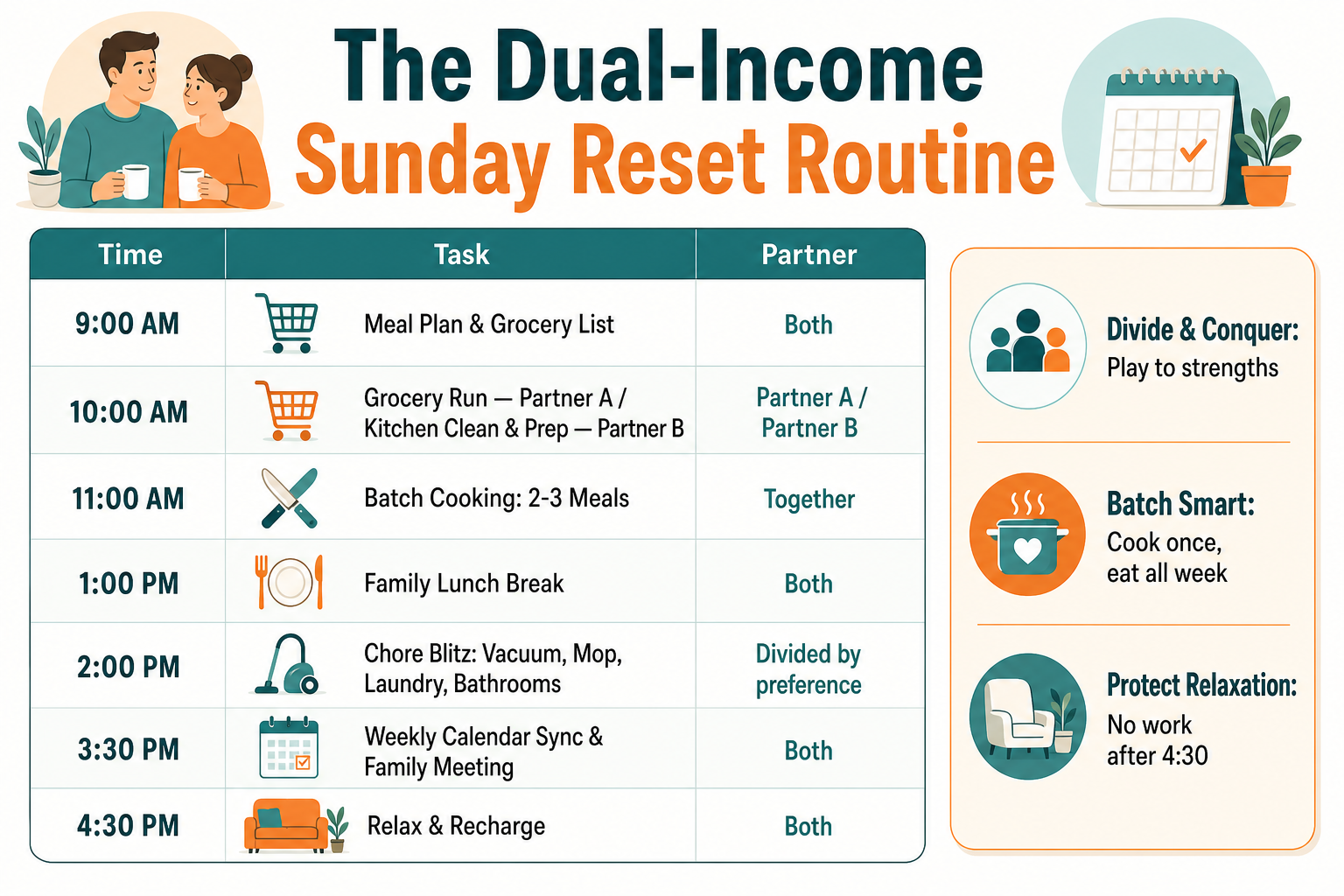
On this page
Start with the familiar Sunday scaries—the dread of a messy house, no meal plan, and a chaotic week ahead—then promise a realistic, proven system that splits the load between partners and gives back your Sunday evening.
Why Sunday Sets the Tone for Your Entire Week

A real Sunday reset is a joint, 90-minute blitz where dual-income couples pre-decide meals, split to-dos, and lay out clothes so the week runs on autopilot. Without it, Monday hits like a truck—forgotten lunch supplies, mismatched socks, and the guilt of a $40 takeout order nobody really wanted. That last-minute scramble isn’t just stressful; it eats up mental bandwidth that you need for work, parenting, and staying patient with each other.
Front-loading the big decisions on Sunday fixes that. When you already know what’s for dinner Wednesday and who’s doing pickup, your brain isn’t burning energy on hundreds of tiny choices all week. Studies show that decision fatigue leads to poorer choices and more procrastination—exactly what a busy household doesn’t need.
But here’s the catch: In a dual-income home, the reset can’t be one person’s solo marathon. It has to be divided, clear, and fast. That’s why the best Sunday resets are short team sprints—each adult owning their lane, so the whole thing wraps in under two hours and you still get an actual weekend.
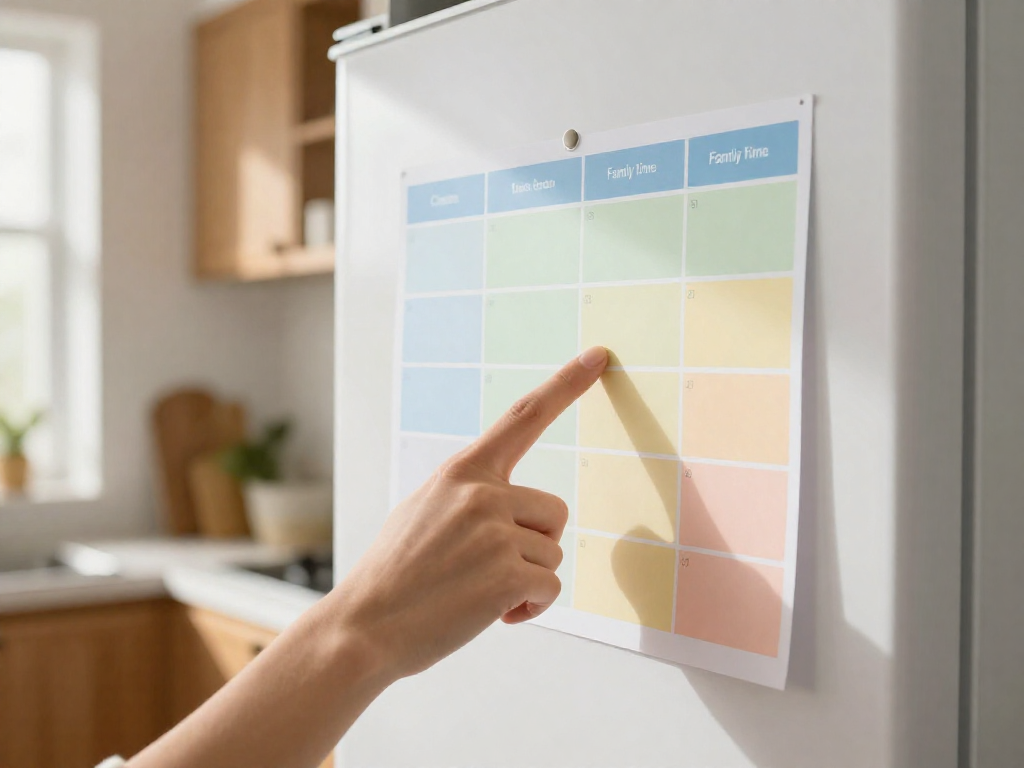
Saturday Night: The 15-Minute Partner Sync

Before Sunday even starts, a 15-minute check-in on Saturday night turns a chaotic day into a smooth, coordinated effort. Sit down with coffee or a nightcap, pull up your shared digital calendar, and scroll through the week ahead. Spot the landmines: the 7:30 a.m. Wednesday meeting that means breakfast prep shifts to the night before, the soccer game that lands during your usual grocery run, the day when both kids have after-school events on opposite sides of town. This isn’t about solving every problem now—just surfacing what’s coming so reset tasks can flex around real life, not a fantasy of an empty week.
Next, divide the Sunday work. One of you might have the knife skills to knock out vegetable prep in half the time, while the other is the laundry ninja who actually folds and puts away. Assign based on energy and skill, not some arbitrary 50/50 split. If one partner is fried from a tough week, they take the lighter load—walking the dog, tidying the entryway—while the other tackles the deep fridge clean-out. The point is to leave the conversation with each person knowing exactly what they own the next morning.
Finally, set a shared intention. "Ready for the week" doesn't mean the same thing every Sunday. After a weekend of hosting guests, maybe it means restocking snacks and doing a quick floor sweep, not a full house reset. Name what success looks like for this particular Sunday: three make-ahead dinners, clean sports uniforms, zero unread emails. When you both agree on the target, you stop overcorrecting or second-guessing each other mid-reset.
Keep it tight. Set a timer if you tend to rabbit-hole. Fifteen minutes is plenty—long enough to align, short enough to avoid turning it into a second job. This tiny ritual is the reason your Sunday will end with feet up, not a frantic scramble at 9 p.m.
Sunday Morning (8 AM–12 PM): Divide and Conquer the Chaos
The best Sunday mornings happen when both partners know exactly what they’re doing, and neither is stuck with the whole load. After the Saturday-night sync, you already have a clear picture of the week’s meals, appointments, and priorities. Now you just execute. The morning runs from 8 AM to noon, divided into four clear sprints that keep things moving without anyone burning out.
Kick things off with a family breakfast. Aim for something that everyone can help make—scrambled eggs and toast, oatmeal with toppings, or a yogurt bar—so you’re not stuck at the stove the entire time. Eat together, then take five minutes for a kitchen quick-clean. This is not a deep clean; it’s a “return to zero.” Dishes go in the dishwasher or get washed by hand, counters get wiped, and the sink is cleared. The goal is a clean slate for the meal prep later.
At 8:30, the house splits into two lanes. One partner grabs a laundry basket and collects anything dirty from bedrooms and bathrooms, starts a load, and does a sweep of the high-traffic zones—living room, entryway, and any hallway clutter. Put shoes where they belong, toss mail, fluff pillows. It’s a surface-level reset, not a deep clean. Meanwhile, the other partner sets up the meal-prep station. Pull out cutting boards, knives, mixing bowls, instant-read thermometer, sheet pans—whatever you’ll need for the batch cooking. If a recipe calls for grains or legumes, get them soaking or in the Instant Pot now. Clear counters mean no friction when you start chopping.
From 9:00 to 10:30, the real work happens. Partner A continues tidying the rest of the house: decluttering flat surfaces (dining table, coffee table, desk), wiping down bathrooms—toilets, mirrors, sinks—and maybe running the vacuum in the main rooms. This is the “company-ready in 30 minutes” standard, not spring cleaning. Partner B starts the heavy cooking. Brown ground beef or turkey for taco bowls, roast chicken thighs for salads, chop onions, peppers, and carrots for sheet-pan meals, or simmer a big pot of soup. If you planned a double batch, now’s the time. The key is parallel momentum: while one scrubs a toilet, the other sauté onions. No one is waiting.
At 10:30, do a quick check-in. Is the meal prep on track to finish by noon? Does the house need a second pass anywhere? This is also the natural point to switch roles if one partner hates cleaning or cooking and needs a break. Some families swap entirely; others just trade one task. Lean into strengths—if one partner loves chopping and the other zen-dusts, don’t fight it—but don’t let anyone get stuck in a role they resent. If you’re on schedule, the partner with the lighter load might slip out to run a short errand—grocery top-up, pharmacy run, library return—while the other finishes cooking and wipes down the kitchen. By noon, the house is tidy, laundry is chugging, and your fridge is stocked with ready-to-go meals for the week. The afternoon is yours.
Sunday Afternoon (1 PM–4 PM): Bulk Meal Prep and Errand Batching
This three-hour block is the engine of your Sunday reset. With one partner fully dedicated to meal prep and the other knocking out all outside errands, you’ll have the week’s food and logistics handled before dinner. The goal isn’t perfection—it’s a repeatable assembly line that gets faster every week.
Meal prep station setup
Start by clearing the counters and pulling out everything you’ll need: Instant Pot or slow cooker, sheet pans, storage containers, and pre-washed produce. If you followed the Saturday night sync, you already have a menu and a shopping list, so the ingredients are ready. Fill the Instant Pot with grains (brown rice, quinoa, farro) while a sheet pan of chicken thighs or tofu roasts. On the stovetop, hard-boil a dozen eggs and blanch green beans or broccoli. The key is overlapping cooking methods so multiple components finish around the same time.
Build lunches on an actual assembly line. Line up five containers and drop in a grain base, a protein, a roasted veg, and a handful of greens. Then close, label, and stack. This takes fifteen minutes once you’ve done it twice. For dinners, batch-cook one or two mains (a big pot of lentil soup, a tray of enchiladas) and pair with the prepped grains and veggies. Snacks get their own station: portion trail mix into small bags, wash grapes, cube cheese. When every container has a lid, you’re done.
Partner roles
One adult owns the kitchen for the full three hours. This person doesn’t answer the door, scroll their phone, or get pulled away. The other adult handles every outside task: grocery pickup, pharmacy, dry cleaning, library returns, even a quick target run. By splitting indoor and outdoor work cleanly, you eliminate the stop-and-start chaos of “do you need me to stir something?”
Errand batching that actually saves time
Errand runner, map your route like a delivery driver. Cluster stops by geography—grocery pickup at 1:15, pharmacy next door at 1:30, dry cleaning across town on the way to the hardware store. Always schedule curbside pickup for groceries and prescriptions; you’ll save at least 20 minutes compared to walking the aisles. Keep a go-bag in the car with shopping totes, returns, and a cooler for cold items. If the loop doesn’t finish by 3:30, drop what’s left and head home. Any errand that doesn’t feed next week’s survival can wait until a weekday lunch break.
Kids: involve or occupy
Young children can decimate a reset if they’re underfoot, so give them a clear role. Toddlers can sort clean socks into pairs, snap green beans, or “wipe” baseboards with a damp cloth. Grade-schoolers can measure rice, label containers, or pack their own snacks from pre-set bins. If they’re too young or simply not cooperating, this is the perfect window for screen time or a standing playdate swap with neighbors. Many families find that a consistent “reset time” becomes a predictable rhythm—kids know that from 1 to 4, the house hums and they’re expected to read, build legos, or watch a movie. It’s not neglectful; it’s teaching them that the family runs on systems, and their cooperation makes it work.
By 4 PM, the fridge is packed, errands are done, and the coming week looks manageable. Stack this habit every Sunday, and you’ll marvel at how little you scramble on Monday morning.
Late Afternoon (4 PM–6 PM): Laundry Fold and Weekday Lineup
This is the last big push, and it’s best done together. Drag the clean laundry baskets to the living room, queue up a show you both like, and fold side-by-side on the couch. The goal is speed, not perfection — match socks in seconds, toss tees into kid-sized piles, and have each person put their own stacks away right after. You’ll be amazed how fast it goes when you’re half-watching Abbott Elementary and chatting.
Once the drawers are full, build a five-day clothing lineup for every family member. In a closet or on a shelf, set out a full Monday-through-Friday outfit — top, bottom, underwear, socks — in labeled cubbies or a hanging organizer. It eliminates the morning scramble and lets kids grab what they need without help. If you’re really tight on space, just stack each day’s outfit into a single drawer or a shoe organizer on the back of a door.
The last fifteen minutes are for staging. Line up backpacks, lunchboxes, and work bags by the door. Restock the diaper bag with wipes and a change of clothes if you have little ones. Tuck keys, wallets, and any permission slips exactly where you’ll grab them Monday morning. When you stand back and see the row of ready-to-go gear, Sunday has officially done its job — the week already feels handled.
Sunday Evening: Protect the Pause
Sunday evening is not a reward for finishing your checklist—it’s a non-negotiable part of the reset itself. When you treat rest as an actual system step, the whole week starts stronger.
Close the day with a screen-free family dinner. No phones, no tablets. Just food and the people who matter most. It’s the simplest way to reconnect and decompress after a packed weekend.
After dinner, pick one low-key wind-down: a short walk, a chapter of a book, or a warm bath. The goal is to signal to your brain that the work is done.
Then, get the parents to bed early. Not “early for parents,” but genuinely early—before 10 p.m. if possible. Starting Monday rested is the single best productivity hack you can give yourself.
Troubleshooting: When Sunday Doesn’t Go as Planned
If your Sunday gets hijacked, split the reset across Saturday evening and Sunday. Move partner sync and a quick kitchen tidy to Saturday night so Sunday isn’t a pressure cooker. When energy is low or sick kiddos are in the mix, shift to the minimum viable reset: rough out next week’s meals, do a ten-minute living-area sweep, and lay out clothes for Monday through Wednesday. Nothing else. For families with older kids, turn part of the reset into their responsibility—let them plan one dinner or manage their own outfit lineup. It lightens your load and builds their planning muscles.
FAQ
What if we have kids' sports or other activities on Sunday?
Move the reset to a different block of time, like Friday evening or Saturday morning, or trim it to the absolute essentials—a 30-minute kitchen speed-clean and a quick meal plan—so the week still starts on track. If Sunday mornings are booked, treat Saturday as your primary reset day and use Sunday only for a 15-minute family tidy-up. The key is to protect a non-negotiable weekly planning window, even if it shifts.
How long should a Sunday reset take for a dual-income family?
A Sunday reset should ideally take just enough time to complete a short list of high-impact tasks without eating into family downtime; many families find that 2–3 focused hours covers meal prep, a quick house reset, and weekly planning. The exact duration depends on your home’s size and the number of meals you batch, but the goal is to keep it lean by rotating deeper cleaning tasks across weeks.
Can we split the reset over Saturday and Sunday?
Yes, splitting the reset is a smart way to avoid burnout. Reserve Saturday for errands and grocery shopping, then use Sunday for meal prep and a quick family tidy-up, or vice versa. Just make sure each block has a clear finish time so the weekend still feels restorative.
What if one partner works on weekends?
Then the reset falls to the other partner or gets condensed into one evening. Choose a consistent weekday night, like Thursday, to do a mini-version: batch two meals, run the robot vacuum, and set the family calendar. The working partner can handle a single task—like folding laundry or prepping snacks—during a break so the load stays shared.
How do we adapt the routine for toddlers or babies?
Adapt by leaning on short, overlapping windows: do high-concentration tasks like chopping while they nap, and involve them in age-appropriate ways like sorting laundry or watching sensory play nearby. Keep the reset list ruthlessly small—tackle only one batch-cook recipe and the most critical tidy zones—and accept that this season is about survival, not perfection.
See also
- Ultimate Bulk Meal Prep Guide for Busy Weeknights
- The Dual-Income Chore System That Saved Our Sanity
- Weekly Planning Templates for Working Parents
- How to Do Laundry for a Family of 4 in 1 Day
Related articles

Weekly Reset for the Unmotivated: A Lazy Person's Guide
How can I create a reset routine that requires minimal effort and willpower?
Jul 31, 2026 · 6 min read

The Friday Night Cleanup: Starting the Weekend with a Clear Slate
Should I do a reset on Friday night instead of Sunday? Discover how a 30-minute family tidy on Friday can reclaim your weekend.
Jul 31, 2026 · 6 min read

Meal Planning as Part of Your Reset: A 5-Step Method
How can I integrate meal planning seamlessly into my weekly reset?
Jul 31, 2026 · 11 min read