Errand Batching vs. Outsourcing: When to Pay for Delivery Services
Should I batch errands myself or use delivery services?
On this page

Start with a relatable scenario of a parent staring at a long weekend to-do list, wondering whether to spend 3 hours driving around or just click 'order now.' Pose the core tension: time vs. money.
The Weekend Errand Trap: Why 'Doing It Myself' Feels Automatic

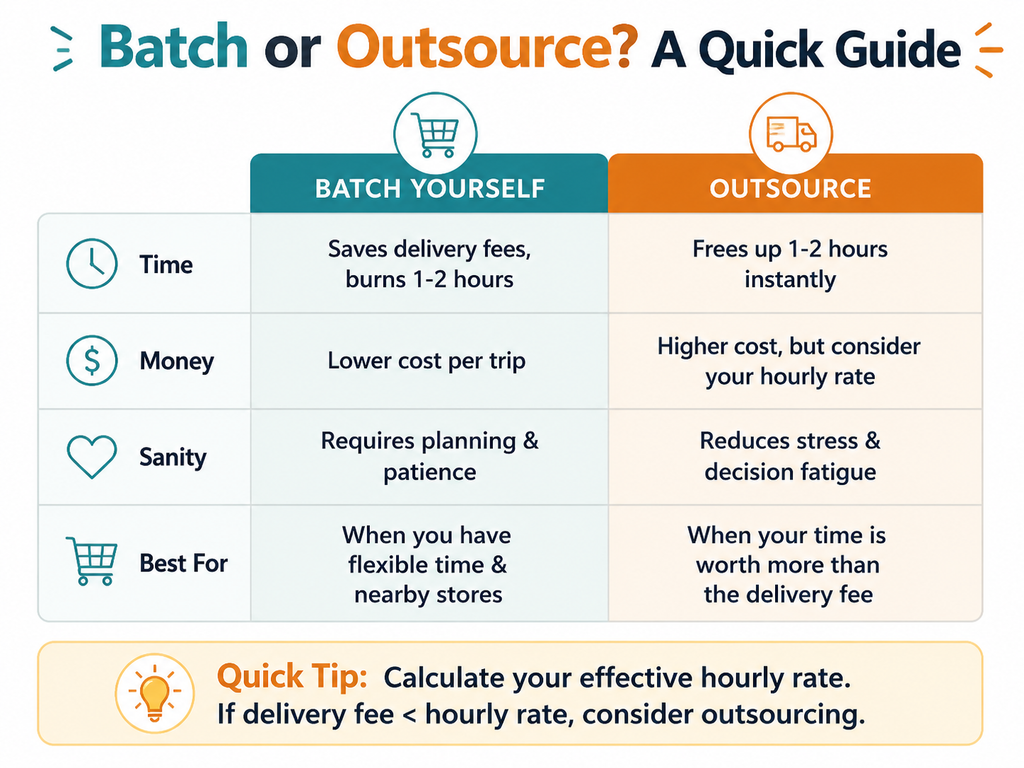
You should mix self-batched errands with delivery services, but only after you measure what an hour of your weekend is actually worth. Picture a typical Saturday: hardware store for furnace filters, two grocery stops because one has better produce, the pharmacy, and a return at the mall. It feels like a productive morning, but tally the driving, parking, and line-standing, and you’ve burned three or four hours—hours that cost you family time, rest, or mental bandwidth. The trap is mistaking “free” for DIY. That errand run wasn’t free; it just hid its cost in your scarce off-hours. The solution isn’t to outsource everything, but to run every recurring trip through a quick framework: if the time commitment exceeds what you’d pay yourself an honest hourly rate (say, what you’d earn in a side hustle or what a restful hour is worth), delivery wins. The rest, you batch into one efficient weekly loop. In the rest of this article, we’ll walk through exactly how to make that call.
What Your Errands Really Cost You: Beyond Gas Money
Self-executed errands feel free because no one hands you a bill at the door, but they quietly drain more than your gas tank. The true cost breaks into four buckets, and once you see them, a delivery fee often looks like a bargain.
First, there’s the vehicle you’re putting on the road. The IRS mileage rate exists for a reason—it bundles fuel, maintenance, tire wear, and depreciation into a single per-mile figure. Every mile you drive for errands chips away at your car’s lifespan and your wallet, long after the pump receipt is forgotten. Short trips around town are especially punishing: cold starts, stop-and-go traffic, and parking-lot idling accelerate wear in ways a highway cruise never does.
Then there’s your time, the cost most of us undervalue. A grocery run isn’t just the minutes inside the store. It’s the round-trip drive, circling for parking, waiting in line, and the mental reset afterwards. If you earn an hourly wage for your day job, calculate what a 90-minute store trip steals from your evening—time you can’t get back for family, rest, or the deep-focus work that actually moves things forward.
Mental load and impulse spending are the sneakiest costs. Planning routes, reconciling lists across stores, and making a dozen micro-decisions under fluorescent lights eats cognitive bandwidth. That fatigue leads straight to the checkout lane extras. Without a script, you grab the snack you didn’t plan for, the “deal” that wasn’t on the list, and suddenly a “quick trip” adds an extra ten or twenty dollars of unplanned spending—often erasing any savings from skipping a delivery fee.
Take a typical grocery run as an example. You drive fifteen minutes each way, wander the aisles for forty-five minutes, and check out with a few impulse buys. The fuel cost is negligible on its own, but the real drain is the mileage depreciation, the hour and a quarter you lost, and the unplanned items. Add it up, and a delivery service’s five- or ten-dollar fee starts looking like the cheaper option—even before you account for the mental space it preserves for the rest of your week.
Delivery Services Decoded: Fees, Markups, and Hidden Savings
When you place a grocery delivery order, the face-value cost breaks down into a few predictable pieces: a per-order delivery fee, a service fee (often a small percentage of your total), and the driver’s tip. These vary by service—some charge a flat rate regardless of order size, while others scale the fee if your cart is small. It’s all spelled out before you hit “order,” so you’re never caught off guard.
What’s less obvious is the markup baked into the items themselves. Services like Instacart quietly raise shelf prices above what you’d pay in the store, sometimes noticeably so. By contrast, first-party platforms like Amazon Fresh or Walmart+ tend to keep prices closer to in-store equivalents—though even there, certain products command a premium. The key is knowing which categories inflate most and checking a few staples against your latest paper receipt before committing.
Subscription bundles flip the math further. Instacart+, Walmart+, and Amazon Prime each remove delivery fees on qualifying orders and often throw in extra perks (like video streaming or extra fuel discounts). If you’re ordering twice a month, these can pay for themselves almost immediately. Even if you only order sporadically, a subscription might still break even when you factor in the time and friction saved on those heavy weeks.
The real edge, however, sits in the savings you don’t spot on the invoice. Delivery radically cuts impulse buys—no endcap displays, no cookies slipping into the cart while you wait for the deli counter. It also eliminates the second trip you’d make because you forgot one ingredient, and it naturally nudges you toward bulk ordering (since you’re not lugging everything home yourself). Less cruising through aisles means fewer surprise snacks and a tighter, more predictable grocery budget. In practice, families often find the service fees are more than offset by a cleaner list and zero store detours.
The Decision Framework: When to Batch and When to Tap a Screen
Stop running errands on instinct. The fastest way to settle the batch-vs.-delivery debate is a simple formula that turns each errand into a number, not a feeling. It’s called your effective hourly rate, and it works like this:
Effective Hourly Rate = (Cost of delivery – Cost of DIY) ÷ Hours saved
Grab the total delivery fee plus any price markup above your usual store, then subtract what you’d spend on gas, parking, and impulse buys if you went yourself. Divide that difference by the time you’d actually spend leaving the house, driving, shopping, and unpacking. The result is what you’re effectively paying to buy back your time. If that number sits well below what you earn per hour or what an extra hour with your family is worth to you, then press order and move on. If it’s painfully high, that errand belongs on your batching list.
Not all errands are created equal, so don’t apply the formula blindly. Split them into two piles: low-value errands and high-value errands. Low-value errands are the repetitive, brainless refills—grocery runs, big-box restocks, dog food pickups. These are prime candidates for delivery. The markup is transparent, the time savings real, and you avoid the 45-minute black hole of a store loop. High-value errands, on the other hand, involve some judgment you don’t want to hand off: a pharmacy consultation where you need to ask about a new medication, a trip to the hardware store where you’re visually matching a weird paint color, or picking up a repaired device that you want to test on the spot. Batch these into a single weekly outing instead.
Next, layer in the practical factors that swing the decision. Distance is the silent budget killer. A 20-minute round trip to a single store can balloon into an hour when you add parking and checkout. If the errand is a quick dash under 10 minutes, DIY often wins; beyond that, delivery starts making serious sense. Number of items matters too. A single prescription pickup is a terrible use of a delivery service’s fee, but a cartload of shelf-stable groceries from a store that waives the fee with a small minimum order flips the calculus. And if you’ve already paid for a subscription—say, an annual grocery delivery pass—the marginal cost of each order drops to nearly zero, so you should default to delivery for anything that qualifies.
To make this a repeatable Saturday-morning routine, build yourself a quick worksheet. It doesn’t need to be fancy—a notes app table or a printed sheet taped inside the pantry works fine. List your recurring errands down the left column, then columns for delivery cost, DIY cost, time saved, and the final hourly rate. Fill it out once for your five most frequent runs and you’ll have a standing cheat sheet. The mental load evaporates: when the milk runs out, you glance at the sheet and know instantly whether to add it to the delivery cart or the weekend loop.
This framework isn’t about penny-pinching every trip. It’s about treating your time as a real line item in the family budget. Once you see the hourly rate on paper, the guilt of outsourcing vanishes—and the resentment of pointless errands goes with it.
The Hybrid Method: Batching Smarter, Not Harder
Pure batching can leave you hauling a cart of paper towels past the melons while your Saturday evaporates, yet outsourcing every errand gets expensive fast. The real sweet spot for busy families is a hybrid: let delivery swallow the bulky, heavy, mindless stuff, then batch the rest into one tight, purposeful weekly loop.
Put the heavy stuff on wheels. Pantry staples, household supplies, diapers, pet food—these are low-perception items you don't need to inspect or select in person. They eat up trunk space and add 20 minutes of aisle-wandering. Schedule them for a midweek delivery. Most services let you lock in a recurring slot, so you never run out of toilet paper on a Tuesday night. Once it's on autopilot, that mental load vanishes.
Batch the fresh, keep the control. Produce, meat, and bakery items reward a quick eye test. Those are still worth a quick in-person sweep—but no more than once a week. Combine that grocery run with other errands that demand physical presence: library returns, prescription pickups, a drop at the post office. String them together in one route so the whole loop takes 90 minutes, not four separate trips.
Layer in curbside as a cheat code. Even on your in-person day, use curbside pickup for non-critical items you'd normally grab inside. Place the order the night before, swing through on your route, and skip the aisles entirely for those goods. It pairs perfectly with a batch of errands that do require you to get out of the car.
What you do with the time matters. The hour you claw back from not wrestling bulk packs into a cart isn't for collapsing on the couch—plow it into high-value family time or a chore that's been nagging you. A Wednesday delivery frees up Saturday morning to prep freezer meals or deep-clean one zone, not just catch up. Treat that saved slot as a non-negotiable appointment.
A real-world weekly rhythm. Wednesday delivery: household staples, bulk grains, canned goods, cleaning supplies. Saturday morning errand batch: farmer's market or grocery run for fresh fruit, veg, and protein; post office returns; hardware store; then home by 10 a.m. The rest of Saturday is yours—no carts, no checkout lines, no second-guessing whether you should have just paid the delivery fee.
This isn't about swinging between extremes. It's about assigning every errand to its most efficient channel so your week feels less like logistics Tetris and more like a system that actually supports your life.
Mistakes That Keep You Stuck in the Errand Cycle
The biggest trap is the all-or-nothing mindset. You either batch every errand yourself or outsource entirely—and both lead to burnout or bloat. Real optimization comes from a hybrid approach: you need a clear rule for when to delegate.
Another mistake is never actually tracking what DIY errands cost you. It’s easy to forget the impulse buys, extra fuel, and the value of an hour of your weekend. Without a quick audit, you can’t compare honestly.
But the cost that matters most? Your family’s headspace. Missing bedtime because you’re stuck in a pickup queue has a price, too. And many overlook subscription perks they already pay for—free delivery with Walmart+ or Amazon Prime can make outsourced errands cheaper per trip than driving yourself. Stop treating errands as a fixed identity and start treating them like any other household system: measure it, then tweak it.
Your FAQs Answered
Is grocery delivery worth it for a family of four? Absolutely, if you regularly lose a Saturday morning to the store. The time saved alone—over two hours for a big trip—can offset the premium. Combine it with a meal-planning routine, and you'll stop impulse-buying, too. How much does batching save? It's not just gas; it's the mental load of deciding to go out three times a week. For most busy families, cutting errand days from two to one frees up a half-day. The biggest hidden cost? It's rarely the delivery fee—it's the invisible tax of holding fragmented to-do lists in your head all week.
Recap: Your Errand Batching Cheat Sheet
Here’s the short version: audit your errands by true hourly cost, batch non-urgent trips to one block, and outsource the rest only when fees buy back more time than you’d earn. That’s the filter.
Grab our free Errand Audit Worksheet — it walks you through the math and builds your weekly template in ten minutes. Download it here. Pick one errand this week and reroute it with the framework. Small change, immediate breathing room.
See also
- How to Create a Weekly Errand Batching Plan
- 10 Batch Cooking Hacks for Working Parents
- The Best Grocery Delivery Services for Families (Compared)
- Time-Saving Chore Systems for Dual-Income Households
Related articles
The Errand List Revolution: From Mental Load to Digital Automations
How can I move from a mental errand list to an automated system?
Jul 31, 2026 · 7 min read

Troubleshooting Your Errand Batching: When Life Throws You Off
When your carefully planned errand batch falls apart due to sick kids, traffic, or last-minute curveballs, here’s how to pivot, salvage your sanity, and build a more resilient system.
Jul 31, 2026 · 10 min read

Errand Batching for After-School Chaos: A Weekday Template
How do I fit errands into the after-school window without meltdowns?
Jul 31, 2026 · 4 min read